
Get support for anxiety
Table of contents
- What is therapy for anxiety?
- What therapy for anxiety can help with
- When to see a therapist for anxiety
- Everyday anxiety vs. generalized anxiety disorder
- How to deal with anxiety
- What does a therapist for anxiety actually do?
- Is online therapy for anxiety a good option?
- What to expect from a first therapy session for anxiety
- When anxiety treatment may need a more urgent approach
- Taking the next step with therapy for anxiety
Therapy for anxiety can help with far more than panic or worst-case stress. While it’s common for people to wonder if what they’re feeling is “serious enough” to talk to someone about, or whether anxiety therapy is only for people in crisis, therapy for anxiety can be helpful long before things feel overwhelming.
If anxiety is starting to affect your sleep, focus, energy, routines, relationships, or ability to relax, it may be time to take a closer look at support. With advice and guidance from Dr. Brian Knox, Included Health’s Clinical Affairs Medical Director, this guide breaks down what therapy for anxiety is, what it can help with, when to see a therapist for anxiety and what to expect, and how to get started from the comfort of your own home.

What is therapy for anxiety?
Therapy for anxiety is mental health support that helps you understand how anxiety is showing up in your life and what to do about it. It’s not just talking about stress — it’s a structured way to look at anxious thoughts, patterns, triggers, physical symptoms, and behaviors that may be feeding your anxiety.
Anxiety therapy can help you build coping skills, recognize what makes your anxiety worse, respond differently when anxious thoughts show up, and feel more in control of your daily life. Depending on what you’re dealing with, therapy for anxiety may focus on current stressors, longer-term patterns, anxiety symptoms that are affecting how you function in your day-to-day life, or a combination of all three.
That’s one reason therapy for anxiety can be helpful for a wide range of experiences. Some people are dealing with constant worry, while others feel stuck in overthinking. Some notice physical anxiety symptoms, while others have had anxiety attacks or panic-like episodes. And some just know they don’t feel like themselves lately and want help figuring out why.

What therapy for anxiety can help with
A lot of people assume therapy for anxiety is only for severe symptoms. But anxiety therapy can help with a much wider range of situations than people often realize.
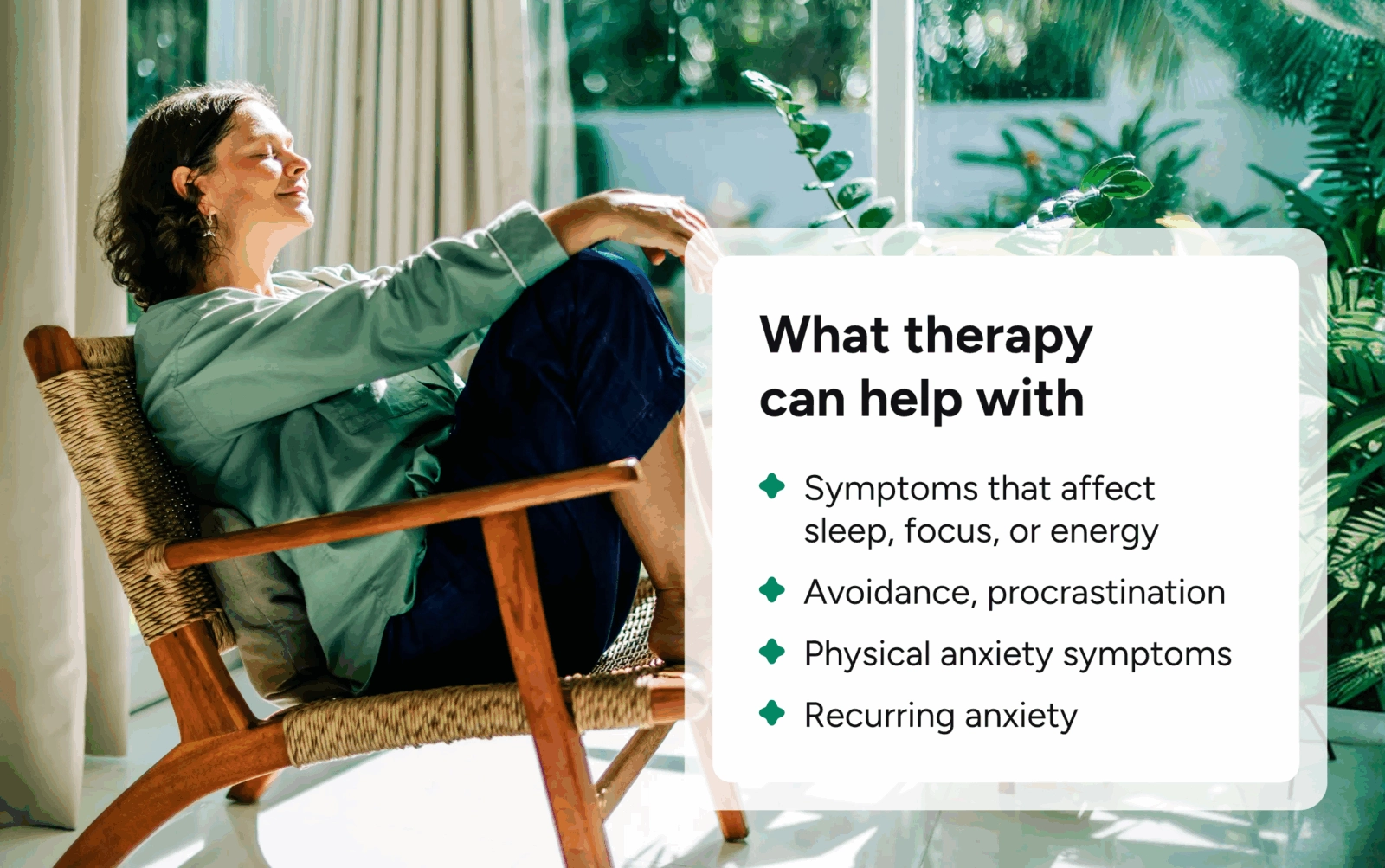
At its core, therapy for anxiety helps you understand what your mind and body are doing, what patterns may be making anxiety worse, and what tools may help you respond differently. That can make a real difference if your anxiety feels constant, situational, physical, or hard to explain. Keep reading for a few key situations where therapy can help.
Persistent worry that’s hard to turn off
If your brain stays busy long after a stressful moment is over, therapy for anxiety can help. This might look like:
- Replaying conversations
- Expecting worst-case outcomes
- Feeling like you can’t shut your mind off
- Worrying about several parts of life at once
A therapist for anxiety can help you understand those thought patterns and start breaking the cycle.
Anxiety symptoms that affect sleep, focus, or energy
Anxiety doesn’t just live in your thoughts. It can show up in your routines, too. You might notice trouble falling asleep, waking up with racing thoughts, brain fog, fatigue, irritability, or that worn-down feeling that comes from always being on edge.
Dr. Brian Knox notes that paying attention to a sleep cycle and the regularity of your sleep cycle is a great indicator of how you’re handling stress. That’s one reason sleep changes can be such an important clue that anxiety therapy is working.
Avoidance, procrastination, or feeling stuck
Sometimes anxiety shows up less as obvious fear and more as avoidance. You may keep putting things off, cancel plans, dread certain situations, or feel frozen when you know you need to act. That can happen with work, school, appointments, travel, or everyday tasks.
If you experience any of those situations, therapy can help you understand what’s underneath that avoidance and build more manageable ways to move through it.
Physical anxiety symptoms
Anxiety symptoms can be physical, too. According to Dr. Knox, “People can develop internalized physical symptoms from stress, anxiety, and other behavioral health issues.” That might look like headaches, stomach problems, muscle tension, a racing heart, feeling shaky, or a constant sense of physical stress.
That doesn’t automatically mean every physical symptom is caused by anxiety. But it does mean your body may be telling you something worth paying attention to, and therapy for anxiety can help you sort out those patterns.
Recurring anxiety attacks or panic-filled moments
If you’ve had an anxiety attack — or moments that feel like panic, sudden fear, or a rush of physical symptoms — that can be especially unsettling. Therapy for anxiety can help you understand what may be contributing to those episodes, how to respond in the moment, and how to reduce the fear that often builds around them afterward.

When to see a therapist for anxiety
The most important thing to keep in mind is that you don’t have to wait until anxiety becomes severe to get support. In fact, therapy for anxiety can be most helpful when you start before it becomes the main thing driving your choices, your routines, or your energy. And Dr. Knox agrees, noting: “Mental health should be core to the way that you think about your health.” That’s a useful reminder that you don’t need to experience a crisis to justify care.
If you want to see a therapist for anxiety but keep second-guessing yourself, that hesitation is common. A lot of people don’t need perfect certainty before reaching out. They just need enough of a reason to take the next step.
Signs therapy for anxiety is worth considering
While you don’t need every sign on this list, if several feel familiar, therapy for anxiety may be worth considering.
Your anxiety shows up most days
If worry feels more constant than occasional, or if you feel like you’re always mentally bracing for something, that matters. Anxiety therapy can help when anxiety starts to feel like your default setting instead of a temporary response.
You’re having trouble sleeping, concentrating, or relaxing
If your mind won’t slow down, your body stays tense, or relaxing feels harder than it used to, therapy for anxiety may help you build tools that actually fit your situation.
You keep avoiding situations because of anxiety
Avoiding social plans, putting off decisions, skipping appointments, dreading travel, or staying away from situations that make you anxious can all be signs that anxiety is shaping more of your life than you want it to.
Your body feels anxious even when you can’t explain why
If you’re dealing with headaches, stomach issues, racing thoughts, muscle tension, restlessness, or repeated anxiety symptoms, those deserve attention too.
Self-help isn’t enough anymore
Breathing exercises, better sleep, journaling, exercise, and grounding tools can all help. But if you’ve tried to deal with anxiety on your own and it still keeps interfering, therapy for anxiety may be the next layer of support you need.
You can read more on simple tips to help manage anxiety if you want self-management ideas alongside therapy.
You keep wondering if you should talk to someone
This is one of the most common signs people brush aside. But if the thought keeps coming back — maybe I should talk to someone, maybe this isn’t just stress, maybe I need more support — it may be time to listen to it.

Everyday anxiety vs. generalized anxiety disorder
Everyday anxiety can happen around stress, uncertainty, major life changes, or specific situations. It might show up before a presentation, during a hard season, after conflict, or when life feels especially heavy. That kind of anxiety can still feel very real, but it may come and go with the situation.
Generalized anxiety disorder is different in that worry tends to be more persistent, harder to control, and spread across multiple parts of life. Someone with generalized anxiety disorder may feel anxious more days than not, even when there isn’t one obvious trigger. The worry may feel excessive, exhausting, or difficult to shut off.
You don’t need to figure out on your own whether what you’re experiencing is generalized anxiety disorder or another anxiety pattern before getting help. A therapist for anxiety can help you understand what you’re noticing and what kind of anxiety treatment makes sense.

How to deal with anxiety
If you’re trying to figure out how to deal with anxiety, there are some things that can genuinely help:
- Getting more consistent sleep
- Limiting overstimulation when you can
- Building in movement
- Journaling or naming patterns
- Practicing grounding or breathing tools
- Setting boundaries around things that increase stress
- Talking with someone you trust
Those tools can make a difference, especially for mild or situational anxiety. But if anxiety keeps interfering with your sleep, focus, work, relationships, or sense of well-being, therapy for anxiety may make more sense than trying to handle it alone.
That doesn’t mean self-help failed. It just means anxiety treatment sometimes needs more than coping tips. A therapist for anxiety can help you go deeper than surface-level advice and build support that’s tailored to your actual patterns.
You can learn more about how to improve mental health for broader habits that support your emotional well-being.
What does a therapist for anxiety actually do?
A therapist for anxiety helps you make sense of what you’re experiencing and build skills to respond to it differently. That may include:
- Identifying triggers
- Spotting thought patterns
- Understanding what happens in your body when anxiety spikes
- Recognizing avoidance patterns
- Practicing coping strategies
- Building routines that support recovery
- Learning how to interrupt anxious cycles sooner
That’s one reason anxiety therapy can feel more practical than some people expect. It’s not just about describing your feelings. It’s about learning how to work with them more effectively.
If you’re not sure where to start, how to find the right therapist can help.

Is online therapy for anxiety a good option?
Yes — online therapy for anxiety can be a very good option for many people.
For some, the hardest part of getting help is all the friction around it. Finding time, commuting, sitting in a waiting room, coordinating schedules, or pushing through anxiety to make it to an in-person visit can all become barriers. Online therapy for anxiety can lower some of that friction and make it easier to get started.
An online therapist for anxiety can help with the same kinds of concerns as an in-person therapist, including ongoing worry, anxiety symptoms, avoidance, anxiety attack patterns, and stress that’s affecting daily life. For many people, an online therapist for anxiety feels more accessible, more private, and easier to fit into real life.
That can matter a lot when anxiety itself makes help feel harder to start.

What to expect from a first therapy session for anxiety
A first therapy session for anxiety usually isn’t about saying everything perfectly. It’s more about giving your therapist a starting point.
They may ask:
- What’s been going on
- What anxiety feels like for you
- How long you’ve noticed it
- What anxiety symptoms you’re dealing with
- How it’s affecting daily life
- What you want help with
You don’t need to show up with a perfect explanation. “I’ve been feeling more anxious lately and it’s starting to affect my sleep” is enough to start.
Your therapist may also talk with you about goals, patterns they’re hearing, and what a helpful next step could look like. If you want a fuller preview, your first therapy session: what to expect can help reduce some of that uncertainty.

When anxiety treatment may need a more urgent approach
Therapy for anxiety can be a strong first step, but it’s not the only kind of anxiety treatment. Some people may also benefit from psychiatry, medication, or a combination of both therapy and psychiatry.
That may be especially worth discussing if:
- Symptoms feel more severe
- Anxiety attacks are becoming more frequent or intense
- Anxiety is making it hard to function day to day
- Therapy alone doesn’t feel like enough
- You want to talk through medication options
Not sure if you need help from a therapist or psychiatrist? Learn more about the difference between therapy and psychiatry.
There are also times when anxiety needs more urgent attention. If symptoms are escalating quickly, you feel unable to function, or you’re having thoughts of self-harm or don’t feel safe, that’s no longer just a routine therapy question. Seek immediate help by dialing 911 to ensure you’re in a safe situation.

Taking the next step with therapy for anxiety
You don’t have to wait until anxiety becomes overwhelming to talk to someone. Therapy for anxiety can help when anxiety is persistent, affecting your day, hard to manage on your own, or simply making life feel harder than it should.
If the situations in this article sound familiar, you may not need more proof that it’s “bad enough”. You may just need permission to take the next step.
Doctor On Demand makes it easy to do just that — from the comfort of your own home. Book a visit to get support from an online therapist for anxiety so you can begin to talk through your anxiety symptoms with someone who can help.
About the authors

Dr. Brian Knox is board-certified in Internal Medicine and Pediatrics, and has been overseeing clinical services at Included Health for the past 3 years. Prior to joining IH 6 years ago, Dr. Knox spent 9+ years providing primary care to adults and children. He has expertise in preventive care, primary care for the LGBTQ+ population, as well as the management of patients with difficult-to-control diabetes and hypertension.

Quan Lam is a copywriter with over 15 years of experience writing and editing content for both start-ups and legacy brands, as well as 2 years of writing experience exclusively within the healthcare space. She currently lives and works in New York City.